If you picture life in Osprey and immediately think "water," you are on the right track. But waterfront living here is not just one thing. In Osprey, your options can range from direct bay frontage to sheltered canals to interior homes that still keep public launch points and shoreline views close by. If you are trying to match your lifestyle to the right kind of access, this guide will help you sort through the differences and ask smarter questions before you buy. Let’s dive in.
Osprey waterfront starts with Little Sarasota Bay
Osprey’s water-oriented lifestyle centers on Little Sarasota Bay, which Sarasota County and the Sarasota Water Atlas identify as a defining local waterbody. The bay is also protected as an Outstanding Florida Water, which matters because it can affect how waterfront improvements are reviewed.
The local watershed covers 43.9 square miles and includes canals, lakes, bays, and bayous. That means when you shop for a home in Osprey, you are not simply choosing between “waterfront” and “non-waterfront.” You are really choosing between different levels of access, exposure, maintenance, and use.
That distinction is important for both buyers and sellers. A bayfront address may offer a very different daily experience, cost profile, and permitting path than a canal-front home or an interior property near public access.
Bayfront homes offer the strongest water connection
If your goal is direct water views and the most immediate relationship with the bay, bayfront homes are usually the clearest fit. In Osprey, county waterfront parks like Bayview Park, West Bay Street Park, and Webb Street Park reinforce how closely this area is tied to Little Sarasota Bay.
For many buyers, bayfront living is about the feeling as much as the location. Open sightlines across the water, shoreline orientation, and easy visual access to the bay are what make these homes stand out.
What bayfront buyers should weigh
The benefits are easy to understand, but the tradeoffs matter. Bayfront homes often come with more exposure to wind, shoreline conditions, and flood-related considerations than a more protected interior or canal setting.
Sarasota County says updated FEMA flood maps issued on March 27, 2024 can affect insurance requirements and premiums. Buyers should confirm the property’s current flood zone and understand that flood insurance is a separate policy.
Because Little Sarasota Bay is an Outstanding Florida Water, dock and shoreline projects may also face more restrictive review than a typical inland lot. If you are hoping to add or expand waterfront improvements later, it is smart to investigate that early.
Boating considerations on the bay
If boating is part of your plan, location on the water does not tell the whole story. Sarasota County notes that north of the Blackburn Point bridge, the Intracoastal Waterway channel is in a manatee refuge with a 25 mph speed limit.
That does not make bayfront living less attractive. It just means your boating routine may include specific speed and navigation considerations depending on where you are.
Canal-front homes prioritize function and shelter
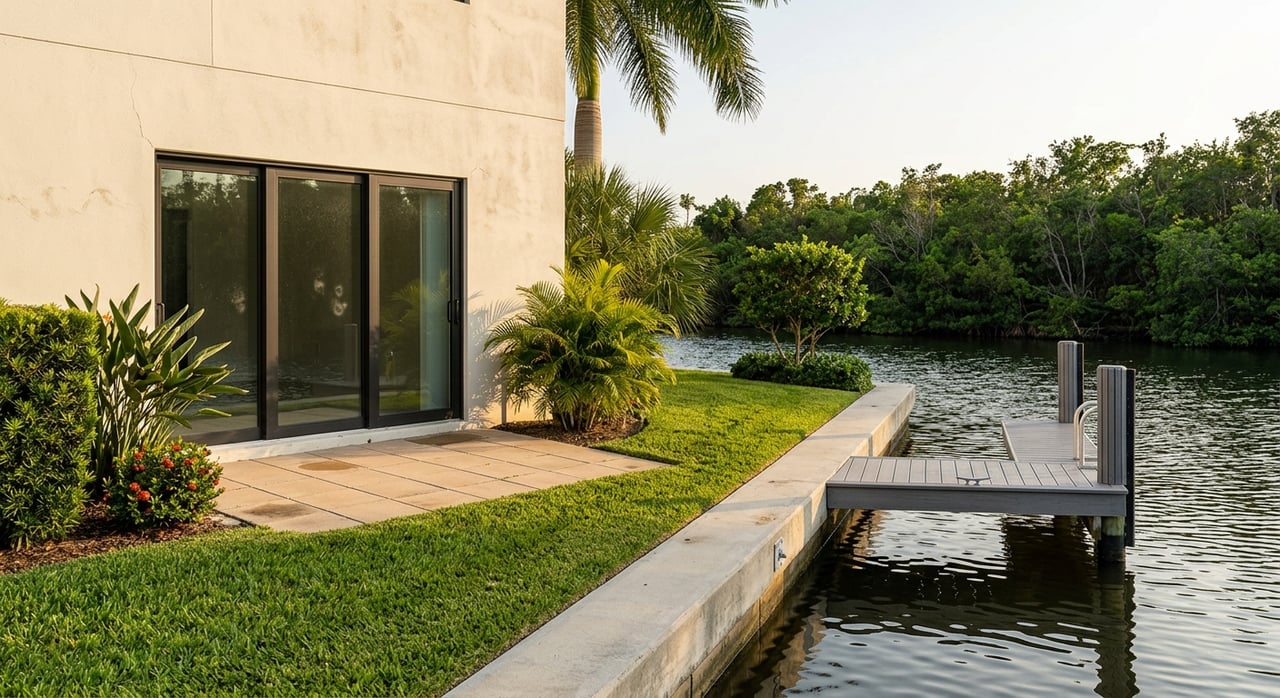
Canal-front homes often appeal to buyers who want the convenience of a private dock or lift with somewhat more sheltered water than an exposed bayfront lot. In many cases, the lifestyle is less about wide-open views and more about practical day-to-day access.
For boaters and anglers, that can be a strong advantage. A canal-front property may support an easier setup for launching, docking, and storing your boat close to home.
What matters most on canal-front lots
When you look at canal-front homes, the key questions usually shift toward function. You will likely care more about:
- Dock size
- Lift capacity
- Seawall condition
- Water depth at different tides
- How well the canal flushes
These are the details that shape how usable the property really is. Two canal-front homes may look similar on paper but perform very differently for your boating needs.
Permitting can still vary
Florida DEP guidance shows that dock permitting rules vary by waterbody and location. Private docks may fall under different approval pathways depending on size, setting, and potential resource impacts.
In Osprey, that matters because a bayfront parcel on Little Sarasota Bay may not follow the same path as a canal-front lot. If a property already has a dock, lift, or seawall, you should ask about the permit history rather than assume future changes will be simple.
Interior homes can still deliver the water lifestyle
Not every Osprey buyer wants the cost and upkeep of direct waterfront ownership. If you want water nearby without managing a private shoreline, an interior home with community or public access may be the best fit.
This option can work especially well if your version of waterfront living is more about paddling, park visits, casual boating, fishing, or scenic walks than about maintaining a dock outside your back door.
Osprey’s public water access network
Sarasota County has invested in several local access points that support this lifestyle. In and around Osprey, notable options include:
- Bayview Park
- West Bay Street Park
- Osprey Fishing Pier
- Webb Street Park
- Blackburn Point Park
- North Jetty Park on nearby Casey Key
Osprey Fishing Pier includes a kayak launch and ADA-accessible parking. Blackburn Point Park offers motorized and non-motorized ramps, a canoe and kayak launch, a fishing pier, trails, and restrooms.
For many buyers, that network changes the equation. You may not need a private dock to enjoy regular time on the water if launch points and shoreline access are already close by.
Verify current park conditions
As of early 2026, Sarasota County says storm-repair work and water-access improvements are still being developed at Osprey waterfront parks. That means buyers should verify current site conditions before counting on a specific launch, overlook, or amenity.
This is especially important if public access is a key reason you are considering an interior home. A quick check can help you avoid assumptions about what is open and ready to use.
Maintenance is more than dock repair
One of the biggest waterfront mistakes buyers make is focusing on the purchase price without fully evaluating ongoing ownership costs. In Osprey, waterfront ownership should be looked at as a total cost package.
That includes flood insurance, shoreline care, dock or lift maintenance, seawall condition, and landscaping practices near the water. A lower-priced waterfront home may not stay lower-cost if major repairs or upgrades are waiting.
Flood and insurance questions to ask
Flood risk exists in every zone, and FEMA notes that flood insurance is a separate policy. Sarasota County’s 2024 flood-map update may also change base flood elevations and insurance requirements for some properties.
Before you move forward on a waterfront purchase, ask:
- What is the current flood zone?
- Did the designation change after the March 2024 FEMA update?
- Is flood insurance required for this property?
- How might the home’s construction and location affect premiums?
These questions can protect your budget and help you compare homes more accurately.
Shoreline upkeep often gets overlooked
Waterfront maintenance is not only about hardscape features. UF/IFAS recommends a 10-foot maintenance-free zone around water bodies with no mowing, fertilizing, or pesticide use in that strip.
That guidance matters in Osprey because shoreline ownership often involves landscaping decisions, erosion concerns, and long-term care practices. If a property includes seawalls, rip rap, or other stabilization features, those should be part of your review too.
How to match the property to your lifestyle
The best Osprey waterfront choice depends on how you actually plan to use the water. A home that sounds ideal in a listing may not fit as well once you think through your routine.
Here is a simple way to frame it:
| Lifestyle Goal | Best-Fit Property Type | Key Consideration |
|---|---|---|
| Wide-open views | Bayfront home | Exposure, flood factors, permitting |
| Private boating setup | Canal-front home | Depth, lift, seawall, canal flushing |
| Lower maintenance | Interior home near access | Distance to parks and launch points |
| Casual paddling and park use | Interior or nearby-access home | Current condition of public access sites |
If you love the idea of sunset views and direct shoreline presence, bayfront may be worth the extra cost and upkeep. If your priority is keeping a boat at home in a more protected setting, canal-front may be the stronger match.
If you mainly want to enjoy Osprey’s coastal setting without taking on shoreline maintenance, an interior home near the county’s access network can be a very practical option.
Questions to ask before buying in Osprey
No matter which property type you prefer, a few questions can help you make a more confident decision. These are especially helpful in Osprey, where access, permitting, and maintenance can vary a lot from one home to the next.
Ask about:
- The current flood zone and whether it changed after the March 2024 map update
- Existing docks, lifts, seawalls, and their permit history
- Whether the lot sits on Little Sarasota Bay, in a canal, or near shared access only
- Your real priority: boating, paddling, beach access, or simply a water view
- How close the home is to county access points if you do not want a private dock
These answers can save you time, clarify your budget, and help you compare homes on more than curb appeal alone.
Why local waterfront guidance matters
Osprey waterfront buying is rarely one-size-fits-all. Two homes can both be described as “water access” properties but offer completely different ownership experiences.
That is why local, property-specific guidance matters. When you understand how flood zones, permitting, public access, shoreline maintenance, and boating patterns intersect, you can choose a home that fits both your lifestyle and your comfort level.
Whether you are searching for direct bay frontage, a canal setup for your boat, or a lower-maintenance home near the water, a clear plan makes the process easier. If you want help comparing Osprey options and understanding what each property type really means, connect with Nick Wikoff.
FAQs
What does waterfront living in Osprey usually mean?
- In Osprey, waterfront living can mean bayfront property on Little Sarasota Bay, canal-front property, or an interior home with convenient access to public parks, launches, and shoreline views.
What is the difference between bayfront and canal-front homes in Osprey?
- Bayfront homes usually offer stronger open-water views and a more direct relationship with Little Sarasota Bay, while canal-front homes often focus more on private dock access, sheltered water, and boating function.
What should buyers check about flood zones in Osprey?
- Buyers should verify the current flood zone, ask whether it changed after Sarasota County’s March 2024 flood-map update, and understand how that may affect insurance requirements and costs.
What public water access options are available near Osprey homes?
- Sarasota County access points include Bayview Park, West Bay Street Park, Osprey Fishing Pier, Webb Street Park, and Blackburn Point Park, with North Jetty Park nearby on Casey Key.
What should buyers ask about docks and seawalls in Osprey?
- Buyers should ask whether the property has a legal dock, lift, or seawall, what its permit history is, and whether future improvements may require additional review or permitting.
Are interior homes in Osprey a good option for enjoying the water?
- Yes. If you want lower maintenance and still plan to paddle, fish, launch occasionally, or enjoy shoreline parks, an interior home near public access can be a strong fit.